1.8 Billion AIS Signals
Broken Chain
An exclusive CommonWealth Magazine analysis of 1.8 billion vessel signals shows how the China Coast Guard has expanded its footprint—from disputed waters between Japan and South Korea to Itu Aba. Is the chain beginning to unravel?

On May 28, 2026, Japan and the Philippines launched negotiations to delimit their exclusive economic zones (EEZs) in the Pacific.
Unexpectedly, the talks marked the beginning of a new challenge to Taiwan's maritime status quo.
- Japan EEZ Claims
- Taiwan EEZ Claims
- The Philippines EEZ Claims
- Japan–Philippines EEZ Overlap
Chinese Government Vessels Head toward Waters East of Taiwan
On June 6, China dispatched four large government vessels from Xiamen to waters east of Taiwan for a “special maritime traffic law enforcement operation.”
- Restricted Waters
- Prohibited Waters
“Law Enforcement” Broadcast to an Evergreen Vessel off Southwestern Taiwan
At 1 p.m. in Taiwan's EEZ southwest of Cape Eluanbi, HAI XUN 06 radioed the Singapore-flagged container ship EVER VISTA, operated by Evergreen Marine, asking for its port of departure, destination and the number of crew members aboard—assuming the role of “law enforcement authority.”
- Restricted Waters
- Prohibited Waters
Enters Restricted Waters and Closes In on Taiwan
The vessels continued moving closer to Taiwan, even entering Taiwan's restricted waters. Taiwan's Coast Guard deployed vessels, including the KAOHSIUNG (CG129), to intercept and drive them away.
This was the closest they came to Taiwan's main island during the operation.
- Restricted Waters
- Prohibited Waters
Joined by China Coast Guard, the Flotilla Enters Japan–Philippines EEZ Negotiation Area
En route to the eastern waters, the four vessels were joined by China Coast Guard vessels already operating there, forming a cross-agency flotilla.
After reaching the waters east of Taiwan, the vessels did not continue circling the island. Instead, they sailed farther east into the area where Japan’s and the Philippines’ EEZs overlap.
- Restricted Waters
- Prohibited Waters
- Japan–Philippines EEZ Overlap
Broadcasts to Foreign Vessels Along Taiwan's Pacific Coast
In Taiwan's EEZ east of the island, Taiwan's Coast Guard overheard Chinese vessels radio the SOUTHERN ROBIN, an oil tanker operated by Japan's Tatsumi Marine, and the Benin-flagged oil tanker AZELIA, requesting information under the guise of “law enforcement.” To counter the Chinese broadcasts, Taiwan's Coast Guard simultaneously radioed the commercial vessels, telling them that China had no jurisdiction and that they did not need to comply.
- Restricted Waters
- Prohibited Waters
Approaching Taiwan's Military Port: Su-Ao
Su-Ao is a major military, commercial and fishing port. It is home to the ROC Navy's largest Kidd-class destroyers and serves as a key base for Taiwan's indigenous shipbuilding program. Lungteh—one of Taiwan's three largest shipbuilders—also has its largest shipyard here.
"Su-Ao could serve as an east coast port for receiving U.S. support if fighting were to engulf Taiwan's west coast," said Ying-yu Lin (林穎佑), an associate professor of international relations at Tamkang University.
- Restricted Waters
- Prohibited Waters
China Declares a “Complete Success”
The flotilla finally turned north and headed back on June 9. China's state-run Xinhua News Agency described the special law enforcement operation as a “complete success,” claiming that the vessels had inspected subsea infrastructure and 198 passing vessels.
- Restricted Waters
- Prohibited Waters
At the Same Time, Chinese Vessels Appeared Near Itu Aba Island
On June 11, before the flotilla had even made it back to port, two more Chinese government vessels appeared near Itu Aba, also known as Taiping Island, in the South China Sea.
- Restricted Waters
- Prohibited Waters
First Incursion into Itu Aba’s Prohibited and Restricted Waters
That day, Chinese vessels entered the restricted waters of Itu Aba at high speed and proceeded into its prohibited waters, coming within just 2.1 nautical miles of shore—a dangerously close distance from which they could reach the coastline in under 15 minutes.
- Restricted Waters
- Prohibited Waters
The repeated appearances of Chinese vessels were not isolated incidents.
"China is escalating maritime coercion across the board, starting fires everywhere," said Deputy Minister Raymond Chen-en Sung (宋承恩) of Taiwan’s Ocean Affairs Council. "And this is not limited to Taiwan. In May and June alone, similar actions occurred from Japan in the north to the Philippines in the south."
Chinese government-vessel tracks, Jan. 1–Jul. 17, 2026
- Chinese Government Vessel


It was an unexpected rendezvous.
On June 6, four large Chinese government vessels departed from Xiamen for waters east of Taiwan. Their mission was to protest Japan–Philippines negotiations to delimit their overlapping exclusive economic zones (EEZs), which Beijing said infringed upon “China's national rights and interests.”
As they passed southwest of Cape Eluanbi, they radioed the Singapore-flagged Evergreen Marine cargo ship EVER VISTA, requesting its name, course and destination. The crew answered each question in Chinese.
For Evergreen, a shipping giant with around 200 vessels at sea at any given time, the exchange was too minor to warrant reporting to headquarters. Radio inquiries from government vessels are not uncommon at sea and are generally left to the captain to handle.
“As long as they are not ordered to stop or submit to boarding and inspection, most crews will give a brief response,” a senior executive at a shipping company said. “After all, they're dealing with state authorities, and no one wants to offend either side.”
Evergreen never imagined that this seemingly routine response would strike a nerve with Taiwan's authorities. Taiwan Coast Guard Administration disclosed the incident to foreign media, explicitly naming Evergreen and emphasizing that the radio response had come from a mainland Chinese crew member.
Little did Evergreen know that it had become part of a historic moment for the First Island Chain.
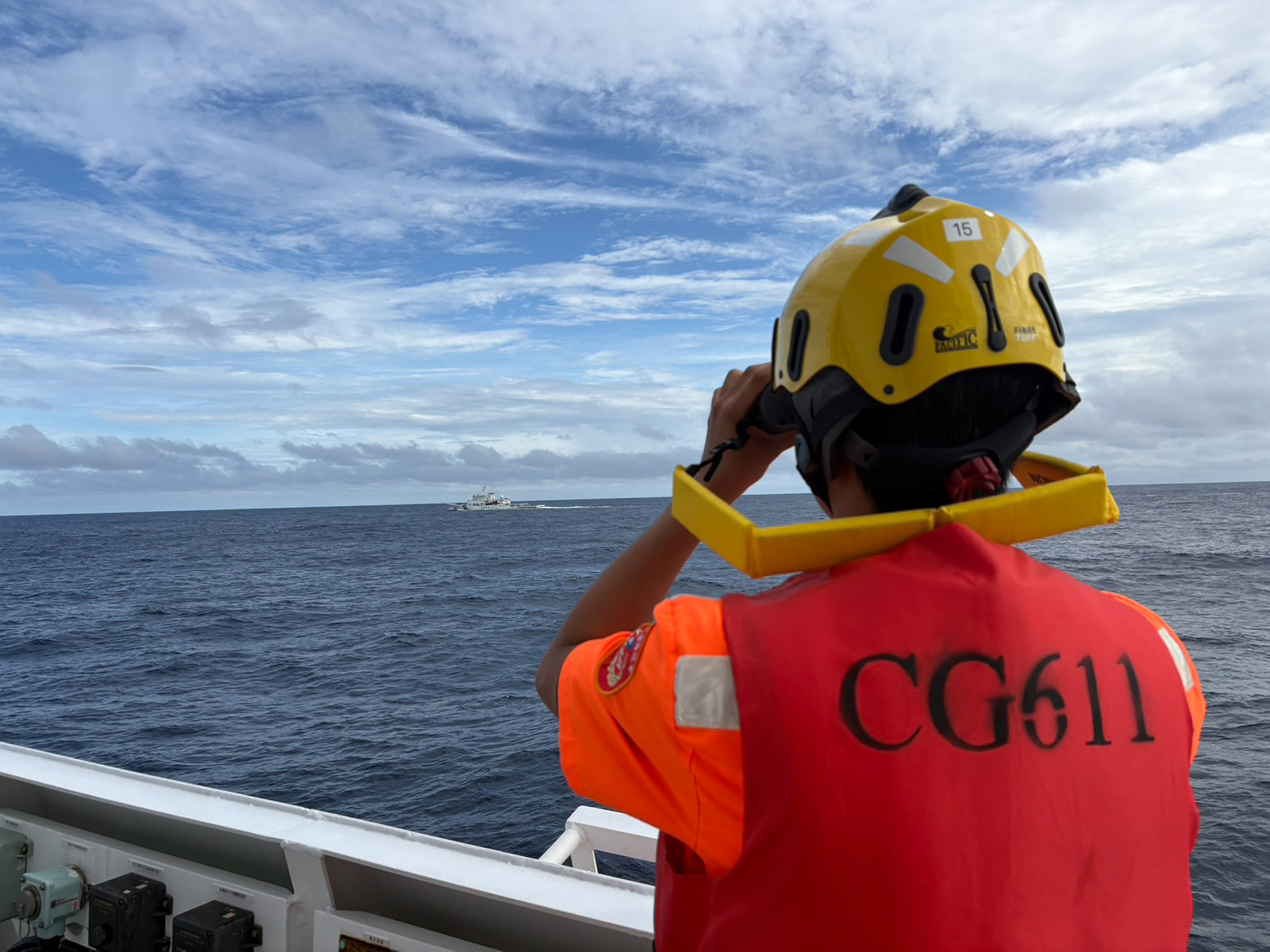
On June 11, the Chinese Communist Party mouthpiece People’s Daily framed the “law enforcement operation” as a “necessary action in response to Japan and the Philippines unilaterally announcing the start of maritime boundary negotiations in the waters east of China’s Taiwan island, gravely infringing upon China’s territorial sovereignty and maritime rights and interests.”
On July 4, the China Coast Guard went further, announcing that law enforcement in the eastern waters would become routine in order to “resolutely safeguard the nation’s territory”—an attempt to establish a new normal along the First Island Chain.
In Beijing's narrative, Taiwan is part of China—it is only natural for Chinese government vessels to enforce Chinese law in what it considers Chinese waters.
China Breaks a Longstanding Cross-Strait Tacit Agreement
This time, Beijing did not respond to the delimitation with its typical People’s Liberation Army (PLA) military exercises. Deploying the PLA, Lin explained, could alarm neighboring countries and provide a pretext for intervention. Law enforcement by government vessels offers a lower-intensity means of asserting sovereignty, with less risk of confrontation. This is also why the coast guard is especially active in disputed waters, including the Diaoyutai Islands (known as Diaoyu in China and Senkaku in Japan), Scarborough Shoal and Second Thomas Shoal in the South China Sea.
"The coast guard is a domestic agency, so its involvement signals that Taiwan is being handled as an internal matter," Lin said.
In footage later released by China, a rescue vessel operating off Hualien and Taitung was shown holding a ceremony to raise the PRC flag on its deck—a gesture carrying a strong assertion of sovereignty.
What is even more alarming for Taiwan is that Chinese government vessels have broken a longstanding cross-Strait tacit agreement not to challenge each other's jurisdiction by taking law enforcement actions.
Beijing has never publicly denied the Republic of China's (ROC) exercise of jurisdiction over Taiwan, Penghu, Kinmen and Matsu since 1949. It even warned Chinese vessels to stay out of "disputed waters" and refrained from encroaching on areas under Taiwan's jurisdiction. That tacit understanding no longer exists.
Though China Coast Guard vessels had previously entered Kinmen's prohibited and restricted waters several times, they had not taken law enforcement action. The 2024 boarding and inspection of a Kinmen tour boat occurred in waters closer to Xiamen. This June, however, Chinese government vessels carried out law enforcement operations in waters where they had never previously exercised jurisdiction—and they even targeted foreign commercial ships.
On June 11, Yuyuan Tantian, a social media account affiliated with China Central Television (CCTV), put the claim even more bluntly: "In the future, the term 'Taiwan Strait' will gradually disappear. ... The waters east of Taiwan Island are our near seas. These are waters in which we maintain a presence, exercise jurisdiction and govern."
China’s Gray-Zone Operations Have Encircled Taiwan
Shifts in Chinese government vessel activity hotspots in recent years
Loading…
The China Coast Guard had spent years preparing to “erase the line.”
CommonWealth Magazine partnered with the Futures Lab at the Center for Strategic and International Studies (CSIS), a leading U.S. think tank, to analyze the distribution of China Coast Guard activity around Taiwan’s main island from 2020 through the first half of 2026, using an analytical model developed by researcher Jose M. Macias.
“What stands out most in 2026 is the clear trend of China Coast Guard activity expanding to the east of Taiwan,” Macias said, “The PRC continues to expand its gray zone pressure campaign against Taiwan to wear down its resources and resolve.”
Beginning in 2020, the China Coast Guard first stepped up its activity in waters southwest of Taiwan. "This is strategically vital territory—the first step in breaking through the First Island Chain," Lin explained. Its operations subsequently expanded toward the Taiwan Strait median line, with the move to waters off Taiwan's east coast marking the latest phase.
Chinese Government Vessels Enter Waters off Itu Aba for the First Time as Dongsha Islands Emerge as a New Hotspot
Dates of reported Chinese government vessel sightings around Taiwan since 2024
Which waters under the ROC’s jurisdiction have faced the greatest pressure?
Kinmen continues to bear the brunt, while Dongsha is gradually emerging as a new, recurring hotspot.
Since February 2025, Chinese government vessels have begun making incursions around Dongsha on the pretext of escorting fishing boats operating across the boundary. They now regularly patrol around the area’s prohibited and restricted waters roughly every one to two weeks.
“Around Dongsha, China is trying to establish a pattern similar to the one it has created around Kinmen,” Sung observed.
The number of days on which Chinese government vessels were active in waters east of Taiwan rose from just two in all of 2024 to nine in the first half of this year.
Chinese government vessels also entered waters around Itu Aba in the South China Sea for the first time.
“China is claiming everything within its U-shaped line in the South China Sea,” said Chung Chieh (揭仲), a research fellow at the Institute for National Defense and Security Research (INDSR). He suggested that this may help explain Beijing's concerns. “After Taiwan's Ministry of Foreign Affairs voiced support for the Japan-Philippines negotiations, China may have begun to worry that the DPP government could make concessions on its South China Sea claims in an effort to garner international support.”
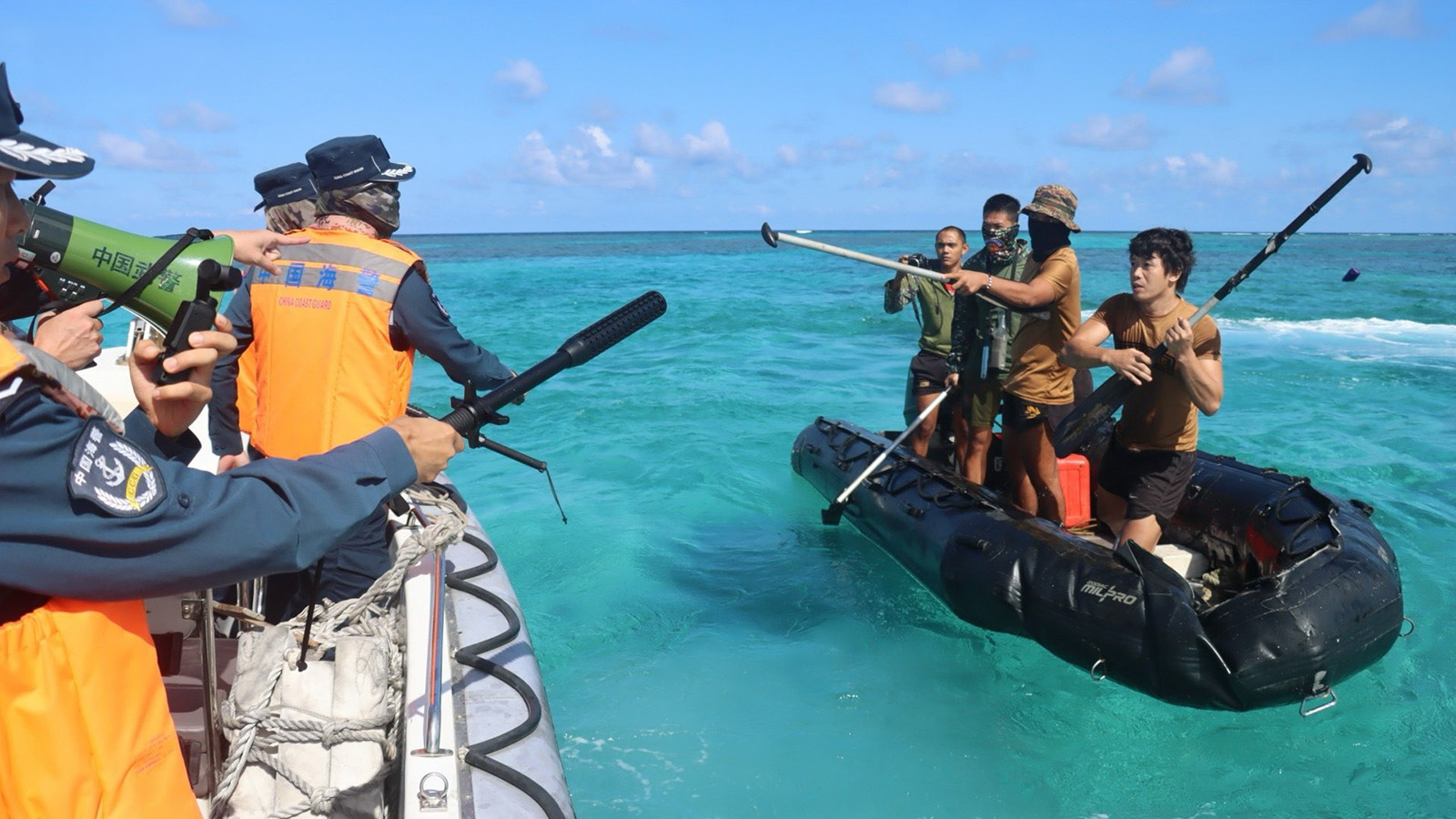
In fact, Chinese government vessels have been operating throughout the First Island Chain in the name of "law enforcement" for more than a decade. Under international law, Beijing is seeking effective control over the islands, reefs and waters it claims, to strengthen the legal basis for its claims.
"International law tends to favor the party that exercises effective control," said Huang-chih Chiang (姜皇池), a professor of international law at National Taiwan University. Whether in the Diaoyutai Islands or the South China Sea, China is seeking to establish effective control in an effort to create a fait accompli.
With negotiations over competing claims at an impasse, the contest ultimately comes down to power. Japan is seeking to preserve the effective control it has maintained over the Diaoyutai Islands for more than a century, while the Philippines is trying to challenge China's control over Scarborough Shoal and Second Thomas Shoal.
地圖載入中⋯
China Has Patrolled the Diaoyutai Islands for 14 Years
The Diaoyutai Islands are a strategic point along the First Island Chain and are claimed by Taiwan, China and Japan. After Japan nationalized the islands in 2012, China began regular patrols. According to the Japan Coast Guard, Chinese government vessels have been present in the waters around the Diaoyutai Islands for more than 300 days a year since 2020.
Chinese government-vessel tracks, Jan. 1–Jul. 17, 2026
- Chinese Government Vessel Activity Intensity Low High
The “Kinmen–Xiamen Model” Takes Shape in 2024
Last year, CommonWealth reported on China Coast Guard gray-zone operations around Kinmen and Xiamen placed enormous pressure on Kinmen's maritime defenses. Since 2024, China has established a clear pattern: four operations a month, each involving four vessels sailing along the boundaries of Kinmen's restricted waters. Chinese personnel even boarded and inspected a Kinmen tour boat in 2024.
At the time, CommonWealth raised a question: "Would this model be replicated in other waters around Taiwan?" One year later, the answer is clear.
Chinese government-vessel tracks, Jan. 1–Jul. 17, 2026
- Chinese Government Vessel Activity Intensity Low High
- Restricted Waters
- Prohibited Waters
Mapping China's Presence Across the First Island Chain
Taiwan is not the sole target. Following the same playbook, China has extended its presence from Japan and South Korea to the South China Sea.
CommonWealth compiled Chinese government vessels identified in announcements by Taiwan Coast Guard Administration and the Japan Coast Guard, as well as in the West Philippine Sea Transparency Initiative's annual reports. We then reconstructed their tracks using Automatic Identification System (AIS) data to reveal China's maritime presence across the First Island Chain.
Chinese government-vessel tracks, Jan. 1–Jul. 17, 2026
- Chinese Government Vessel Activity Intensity Low High
Yellow Sea: Overlapping Chinese and South Korean EEZs and Ieodo
Since 2018, China has deployed aquaculture platforms in the overlapping EEZs, prompting protests from South Korea. At the southern end of the area lies Ieodo, which is also claimed by both China and South Korea. As a result, both sides operate frequently in the Yellow Sea.
Chinese government-vessel tracks, Jan. 1–Jul. 17, 2026
- Chinese Government Vessel Activity Intensity Low High
- China–South Korea Provisional Measures Zone
East China Sea: Pinghu and Chunxiao Oil and Gas Fields
Oil and gas fields are another focal point of competition. Since developing the Pinghu and Chunxiao oil and gas fields in 1998 and 2005, China has also conducted patrols in the surrounding waters. "China and Japan have yet to reach an agreement on maritime delimitation in the East China Sea, so these oil and gas fields remain disputed," said Masafumi Iida (飯田将史), a consultant to the Japan Coast Guard and a director at the National Institute for Defense Studies.
Chinese government-vessel tracks, Jan. 1–Jul. 17, 2026
- Chinese Government Vessel Activity Intensity Low High
South China Sea: Dongsha Islands
In June, as China stepped up its activity in waters east of Taiwan, its coast guard vessels also operated jointly with a marine survey ship around Dongsha for the first time. Taiwan's Ocean Affairs Council also found that some vessels detoured around Dongsha while traveling to and from disputed waters with the Philippines.
Chinese government-vessel tracks, Jan. 1–Jul. 17, 2026
- Chinese Government Vessel Activity Intensity Low High
- Restricted Waters
- Prohibited Waters
South China Sea: Scarborough Shoal
Following the 2012 standoff between China and the Philippines, China gained effective control of Scarborough Shoal and began restricting access by Philippine fishermen. Scarborough Shoal has since become a key example of how China uses government vessels to consolidate maritime control and remains one of the South China Sea's most volatile flashpoints.
According to the latest observations by the Asia Maritime Transparency Initiative (AMTI) at CSIS, China Coast Guard vessels were present at Scarborough Shoal every day during the first half of 2026.
Chinese government-vessel tracks, Jan. 1–Jul. 17, 2026
- Chinese Government Vessel Activity Intensity Low High
South China Sea: Second Thomas Shoal
In 1999, the Philippines grounded a naval vessel at Second Thomas Shoal and has since maintained a military presence there. In recent years, Chinese government vessels have repeatedly obstructed Philippine resupply missions using water cannons, ramming and close-range interception.
On July 20, both China and the Philippines accused each other of attacking personnel with wooden sticks and paddles at Second Thomas Shoal. Two days later, Chinese Foreign Minister Wang Yi and Philippine Foreign Secretary Maria Theresa Lazaro exchanged sharp protests over the incident at the ASEAN Foreign Ministers' Meeting.
Chinese government-vessel tracks, Jan. 1–Jul. 17, 2026
- Chinese Government Vessel Activity Intensity Low High
On the map, these islands are thousands of kilometers apart. Yet the playbooks behind the operations are strikingly similar.
After comparing data from Kinmen and the Diaoyutai Islands, Yun-hu Yeh (葉雲虎), chair of the Department of Maritime Police at Central Police University, found similarities in the number of vessels, the frequency of patrols and the way they loitered in both areas. The findings suggest that Beijing's operations across different waters may follow the same standard operating procedures.
Yeh pointed out that China is treating different waters as testing grounds, with tactics learned in one area later applied to another. For example, methods learned from confrontations with Vietnamese maritime militia were later adapted for use against the Philippines. "What China is rehearsing in the Philippines today could appear around Taiwan in the future," Yeh said.
Renato Cruz De Castro, a professor at De La Salle University, said China's pressure campaign against the Philippines has gone a step further. In recent years, Beijing has deployed what he calls the "three dragons" — the China Coast Guard, the maritime militia and the PLA Navy — in a coordinated effort.
Since late 2024, international intelligence has detected Chinese vessels operating in waters east of the Philippines and even as far as Guam.
Taiwan's Delicate Position Between China, Japan and the Philippines
The ROC also claims sovereignty over the Diaoyutai Islands and islands in the South China Sea. During the Ma Ying-jeou administration, Taiwan set aside sovereignty disputes while maintaining its claims, reaching separate agreements with Japan and the Philippines to address fishing rights and coast guard coordination.
Kuan-hsiung Wang (王冠雄), a professor of international law at National Taiwan Normal University, argued that as China, Japan and the Philippines compete for control over EEZs that Taiwan also claims, Taipei cannot simply remain on the sidelines and call for restraint. "Otherwise, no matter how the disputes are resolved, Taiwan will be left in an awkward position," he said.
This time, Chinese government vessels directly radioed international commercial ships and demanded that they report information. From the perspective of the U.S. and its allies, the issue extends beyond cross-strait sovereignty disputes to the freedom of navigation in the Indo-Pacific.
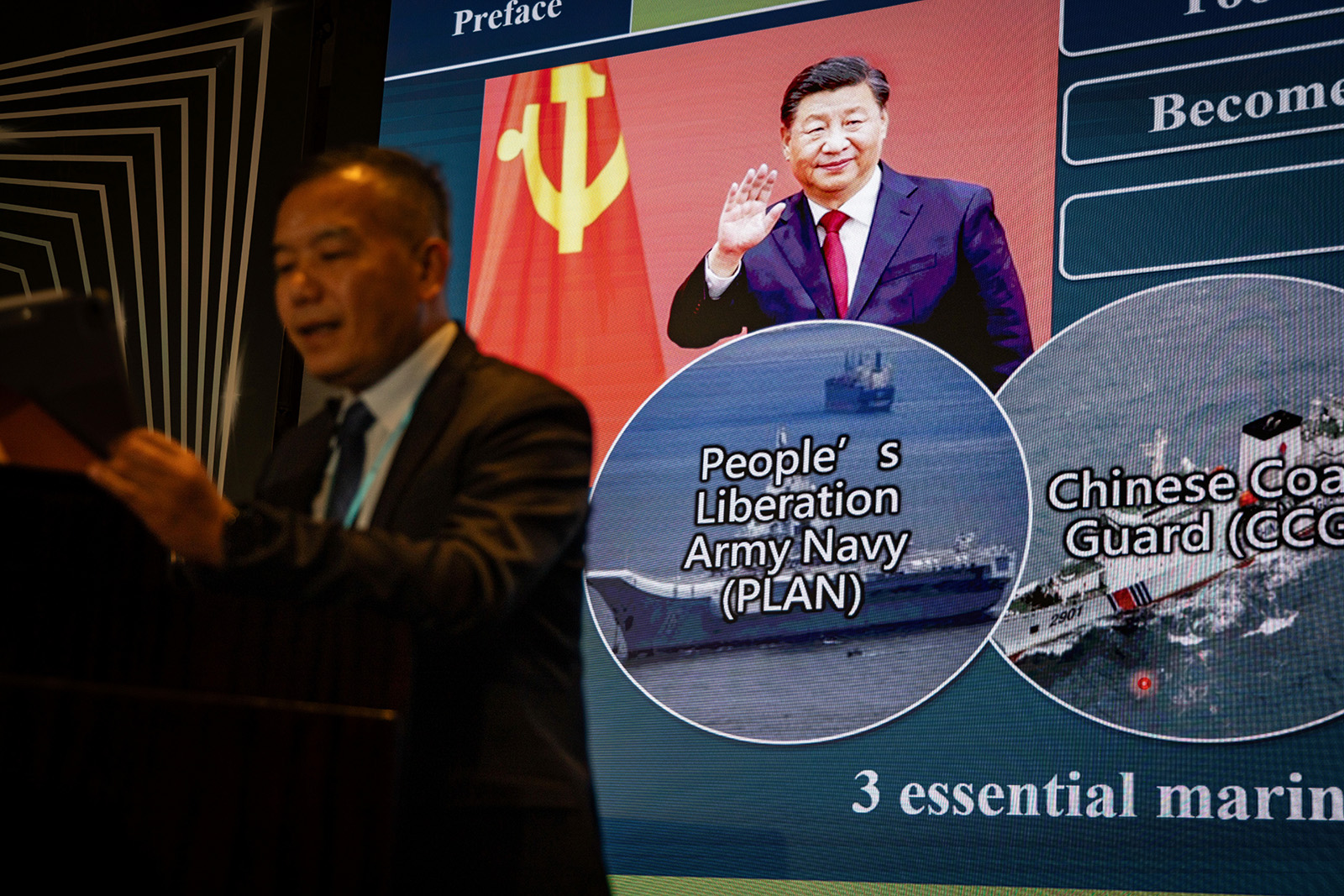
When U.S. Secretary of State Marco Rubio visited the Philippines in late July, he told reporters: "We’re never going to accept that international waterways are somehow under the control of other countries."
The Royal United Services Institute (RUSI), a British think tank, has described the China Coast Guard's activities as part of Beijing's effort to reshape the regional and international maritime order.
The representative offices of the United Kingdom, France and Germany in Taiwan issued their first-ever joint statement on a Taiwan-related issue, warning that China's "new activities" in waters east of Taiwan threaten regional stability, freedom of navigation and security. They also reaffirmed their opposition to any unilateral attempt to change the status quo.
More Dangerous Than Military Drills
The threat goes beyond challenges to Taiwan's jurisdiction and the cross-strait status quo. Taiwan also faces the prospect of a "quarantine."
Unlike a military blockade, in which the PLA prevents all vessels from entering or leaving Taiwan, Lin explained, a quarantine allows Beijing to decide who may enter or leave. It would prevent Taiwan's government from protecting vessels in waters under its jurisdiction, thereby changing the status quo.
Ray Powell, director of Stanford University's SeaLight project, warned that China's quarantine strategy is already taking shape.
"They wouldn't come out all at once and announce, 'We're quarantining Taiwan,'" Powell said. "Today, they patrol the waters and challenge commercial ships over the radio. Tomorrow, they could stop and inspect them, then cite some kind of 'violation' to reroute a ship to the mainland—or even turn it around."
"This poses a far greater threat than PLA military drills," Lin said.
"The most dangerous moment in a gray-zone campaign is when people come to accept the presence and law enforcement activities of China Coast Guard vessels as the new normal," said Jyun-yi Lee (李俊毅), a research fellow at INDSR. By then, the order in waters around Taiwan could be rewritten without a single shot being fired. “It won't matter how capable our military is—it will have no role to play.”
That is why every protest from allies and every Coast Guard operation to drive Chinese vessels away matters. What is ultimately at stake is how the world perceives who has jurisdiction over these waters—and what constitutes the status quo.
Wu-yueh Chang (張五岳), director of the Center for Cross-Strait Relations at Tamkang University and a longtime scholar of Beijing's Taiwan policy, warned that if China Coast Guard operations escalate to the point of effectively quarantining Taiwan, "It would be Taiwan's greatest crisis since 1949."
Methodology
How We Mapped Chinese Maritime Activity Around Taiwan?
We compiled Chinese government vessels identified in announcements by Taiwan Coast Guard Administration, the Japan Coast Guard and the West Philippine Sea Transparency Initiative. We then matched each vessel to its Maritime Mobile Service Identity (MMSI) in maritime databases to obtain AIS tracks. Tracks with anomalous speeds or long intervals between position reports were excluded. The remaining observed positions were then used to estimate activity hotspots.
Research Support
Jose M. Macias, Research Fellow, CSIS Futures Lab
Written by
Ashley Lee, Shu-ren Koo, Kwangyin Liu
Additional reporting
Hazel Hsu
Research
Steven Yeo
Produced by
Ying-yu Chen, Steven Yeo, Yu-hsin Lee